
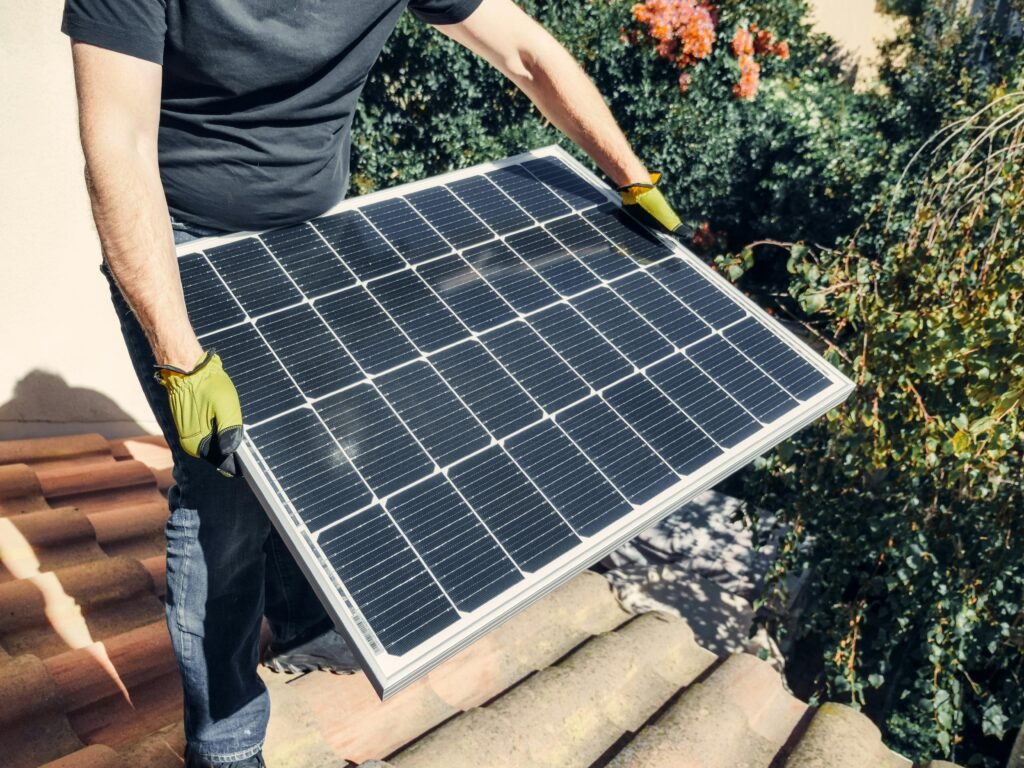

Solar Panel Efficiency Guide – Monocrystalline vs. Polycrystalline
Introduction: Why Solar Panel Efficiency Matters
Solar panel efficiency tells you how much of the sunlight hitting a panel turns into electricity. Higher efficiency means more watts from less roof space, which is a big deal if your roof is small, shaded, or chopped up by vents and dormers. In 2025, modules commonly ship in the 400–600 W range and overall hardware prices have trended down. That said, efficiency isn’t everything: if you’ve got plenty of space and a tight budget, the “best” choice can be different from a compact urban roof where every square foot counts.
From the field, I’ve seen a clear shift: monocrystalline (mono) has become the mainstream standard for homes and most commercial rooftops, largely because it packs more watts per square foot and ages gracefully. Polycrystalline (poly) still works, but availability is dwindling, and the value gap has narrowed so much that poly’s “budget” advantage is often modest.
Understanding Solar Panel Efficiency Basics
What Does the Efficiency Percentage Mean?
If a panel is rated at 22% efficiency, it means that under ideal test conditions it converts 22% of incoming sunlight into electricity. Put simply: higher % = more power from the same area. Think of efficiency like how “fuel-thrifty” an engine is—two cars can be the same size, but the one with the better engine goes farther on the same gas. In solar, the “engine” is your cell technology.
A quick, practical translation: at the industry’s standard test irradiance (1,000 W/m²), a 22% panel delivers about 220 W per square meter (≈ 20.4 W/ft²). A 16% panel would be around 160 W/m² (≈ 14.9 W/ft²).
Lab vs. Real-World Efficiency
Spec sheets are measured at STC (Standard Test Conditions): 1,000 W/m², 25 °C cell temperature, and a perfectly perpendicular sunbeam. On actual roofs, it’s hotter, wind varies, and light hits at angles. That’s why many engineers also look at NOCT/NOMC ratings (closer to reality): sunnier roofs run hot; heat reduces output. In practice, I plan for 10–20% less than the perfect-lab scenario to reflect heat, losses, minor shading, and dust.
Monocrystalline Solar Panels Explained
Manufacturing Process
Monocrystalline cells are grown from a single crystal of ultra-pure silicon (Czochralski method), sliced into wafers, and assembled into modules. The uniform crystal structure improves electron flow—which is a big factor behind mono’s higher efficiency.
Visual Characteristics (Black Appearance)
Most mono modules look deep black and clean. That uniform look blends well with dark shingles and modern facades, which is one reason homeowners ask for mono far more often in my projects.
Typical Efficiency Range (18–24%)
Mono commonly lands around 18–24% in 2025. At the roof level, that translates to roughly 18–24 W/ft² under STC, with your real-world number depending on climate, tilt, and shading.
Lifespan & Degradation Rates
Mono typically carries 25–30-year performance expectations. In the field, I plan around ~0.5%/year degradation. As a rule of thumb, a 400 W mono panel installed today might be near 320–340 W after 25 years, assuming normal conditions and maintenance.
Polycrystalline Solar Panels Explained
Manufacturing Process
Polycrystalline silicon is formed by cooling molten silicon into multi-crystal blocks and slicing them into wafers. It’s simpler to make, historically cheaper, but the grain boundaries introduce resistance that generally lowers efficiency.
Visual Characteristics (Blue Appearance)
Poly panels usually look blue and speckled with a visible crystal pattern. On residential roofs, some folks consider it a more “industrial” look compared to mono’s clean black finish.
Typical Efficiency Range (15–17%)
Poly typically sits around 15–17%. That’s a meaningful gap versus mono when roof area is tight, since lower efficiency means more panels to reach the same system size.
Lifespan & Degradation Rates
Poly modules are time-tested too, but I plan slightly more conservatively—around ~0.7%/year degradation and 20–25 years of reliable service. That difference, plus efficiency, is why poly has steadily lost ground in the residential market.
Side-by-Side Efficiency Comparison
Performance in High Temperatures
Heat is the quiet power thief. I use these field-proven rules of thumb:
- Mono: about −0.3% per °C above 25 °C
- Poly: about −0.4% per °C above 25 °C
In hot climates and on dark roofs, mono’s gentler temperature coefficient keeps more of its nameplate power.
Performance in Low Light
Under overcast skies or early/late sun, mono (especially PERC mono) consistently holds a ~5–10% edge in my installs. That advantage adds up over a year, especially in shoulder seasons and cloudy regions.
Space Efficiency (Watts per Square Foot)
- Mono (18–24%): ~16.7–22.3 W/ft² (STC)
- Poly (15–17%): ~13.9–15.8 W/ft² (STC)
If your roof is small or you’re navigating setbacks, vents, and ridgelines, mono’s higher W/ft² is the safer bet.
Cost Analysis: Monocrystalline vs. Polycrystalline
Price per Watt Comparison
What I’m seeing in 2025 hardware buys:
- Mono: ~$0.80–$1.20/W
- Poly: ~$0.60–$0.90/W (if you can still source it)
That gap used to be dramatic; now it’s often < 15–20%. Because mono is so dominant, it benefits from scale and steady innovation.
Total System Cost Implications
Fewer mono panels for the same target wattage can mean less racking, wiring, and labor, partly offsetting the higher $/W. For a typical 5 kW residential system (equipment + typical BOS, not counting local incentives), I still see:
- Mono 5 kW: roughly $8,000–$10,000
- Poly 5 kW: roughly $7,000–$9,000
Local codes, roof complexity, and inverter/storage choices swing these numbers more than panel type alone.
ROI Timeline Differences
Because mono squeezes more energy out of the same roof area (and tends to age a touch better), payback often lands around 6–8 years for mono and 7–9 years for poly in like-for-like scenarios. Your local rates, incentives, and shading are the big ROI drivers.
Aesthetic Considerations
Curb Appeal & Home Value
Most homeowners I work with prefer the all-black mono look—it reads “clean, modern” from the street. Aesthetics are subjective, but if you care about curb appeal (or HOA harmony), mono generally gets the nod. On high-visibility roofs, it’s the default request nine times out of ten.
Emerging Technologies: PERC, Bifacial & Half-Cut Cells
How These Improve Monocrystalline Efficiency
- PERC (Passivated Emitter and Rear Cell): adds a rear surface layer that captures more light bounce-back, effectively boosting low-light and hot-roof performance by ~1–2% in the real world.
- Half-Cut Cells: each cell is split in two, reducing resistive losses and improving shade tolerance across the string—call it ~2–3% practical gain on complex roofs.
- Bifacial Mono: harvests light from both sides. On light-colored surfaces (white TPO, concrete, snow), I’ve seen +10–30% backside contribution in the right geometry—great for ground-mounts; less pronounced on typical asphalt shingle roofs unless you plan for it.
These are all reasons mono keeps widening the practical performance gap even when spec-sheet efficiency looks close.
Environmental Impact & Sustainability
Manufacturing mono is energy-intensive, but because it produces more energy per panel over a longer life, the lifecycle footprint per kWh can be lower than you’d expect. Poly historically took a little less energy to produce, but if it delivers fewer kWh and has slightly higher degradation, the total impact can favor mono on real-world rooftops. Recycling pathways for glass, aluminum, and silicon have improved; plan to buy from brands with clear take-back and recycling statements and third-party certifications.
Warranty Comparison by Panel Type
- Monocrystalline: commonly 25-year product and 25-year performance warranties, with end-of-term output guarantees around 80–92% depending on brand line.
- Polycrystalline: typically 20–25 years on performance; product warranties can be shorter on older or value lines.
Warranties vary by manufacturer and model line; the fine print matters. Check product (defects) vs performance (output over time) and the allowed annual degradation.
When to Choose Monocrystalline
Choose mono if you want:
- Maximum energy from limited roof space
- Stronger performance in heat and low light
- A cleaner, black-on-black look
- Simpler sourcing in 2025 (wide availability)
- Long-haul durability and top-tier warranties
Field note: On a typical 5 kW target, I often hit it with about 12 mono 400 W modules on compact roofs when layout forces small arrays (nameplate ~4.8 kW), whereas poly often pushes the count—and space—higher.
When to Choose Polycrystalline
Poly can still make sense if:
- Up-front cost is the priority and you find a reputable poly line at a clear discount
- You have plenty of roof or ground-mount space
- A classic blue panel look suits the project or you’re matching legacy arrays
Reality check for 2025: poly is harder to source in many channels, and the historical bargain isn’t what it used to be. If the discount isn’t meaningful, mono usually wins.
Top Manufacturers by Panel Type
- Monocrystalline (popular lines, 2025): JinkoSolar, Qcells, Canadian Solar, REC—widely used in residential/commercial with strong efficiency tiers and bankable warranties.
- Polycrystalline (limited availability): Some legacy or value lines from major brands may remain, but many manufacturers have phased down or retired poly in favor of higher-efficiency mono families.
Quick Panel Count Examples (Mono vs. Poly)
Assumptions: 400 W mono vs 350 W poly modules. Counts rounded up to whole panels.
| Target System Size | Mono (400 W) | Poly (350 W) |
|---|---|---|
| 3 kW | 8 panels (~3.2 kW) | 9 panels (~3.15 kW) |
| 4 kW | 10 panels (4.0 kW) | 12 panels (~4.2 kW) |
| 5 kW | 13 panels (~5.2 kW) | 15 panels (~5.25 kW) |
| 7.5 kW | 19 panels (~7.6 kW) | 22 panels (~7.7 kW) |
| 10 kW | 25 panels (10.0 kW) | 29 panels (~10.15 kW) |
On real roofs, layout and setbacks matter; that’s why I often design to “fit the roof first” and then tune the DC/AC ratio.
At-a-Glance Comparison Table
| Aspect | Monocrystalline | Polycrystalline | What It Means for You |
|---|---|---|---|
| Typical Efficiency (2025) | ~18–24% | ~15–17% | Mono gets more power per square foot. |
| Temp Coefficient (roof reality) | ≈ −0.3%/°C | ≈ −0.4%/°C | Mono retains more power in heat. |
| Low-Light Behavior | ~5–10% stronger in practice (esp. PERC) | Weaker in cloudy/edge-of-day | Mono smooths out cloudy days. |
| Space Efficiency (STC) | ~16.7–22.3 W/ft² | ~13.9–15.8 W/ft² | Fewer panels for the same size. |
| Price per Watt (modules) | ~$0.80–$1.20/W | ~$0.60–$0.90/W | Gap has narrowed; check total system cost. |
| Typical Warranties | 25-yr product & performance common | 20–25-yr performance; product may be shorter | Read the fine print and degradation rates. |
| Availability (2025) | Very high | Shrinking | Easier to source mono SKUs fast. |
| Best Fit | Small/complex roofs, premium look, long-term ROI | Large/simple sites chasing lowest upfront | Mono is the safe default for most homes. |
If you’re picking panels in 2025, monocrystalline is the safe, future-proof default for most homeowners: better watts per square foot, steadier performance in heat and low light, and robust warranties from well-known brands. Polycrystalline still works and can save some money up front if you find a reputable model at a real discount and you have space—but the availability gap and modest performance hit often tilt the math toward mono.
When I design systems, I start with your roof constraints and energy goals, then weigh efficiency, cost per watt, warranties, and aesthetics. That approach consistently lands on modern mono (often PERC and half-cut) for the cleanest install and strongest long-term value.
Efficiency is crucial, but it’s only part of the decision. For a roadmap that also compares financing, installation types, and long-term ROI, see our Residential Solar Guide 2025.
FAQs
What does “22% efficiency” actually mean on my roof?
Under lab conditions that panel converts 22% of sunlight to electricity. On roofs, heat and angle lower it, so design for real-world NOCT/NOMC performance and expect 10–20% less than the lab peak over a year.
Do mono panels really handle heat better?
In practice, yes. Mono’s typical −0.3%/°C vs. poly’s −0.4%/°C means less heat loss on hot roofs.
How many panels do I need for 5 kW?
With 400 W mono, about 13 panels (some layouts succeed with 12). With 350 W poly, plan on ~15 panels.
Is poly still worth it?
If the discount is meaningful and you have ample space, it can pencil out. But with poly availability shrinking and the performance gap, mono usually wins for homes.
What are PERC, half-cut, and bifacial in plain English?
Upgrades that reduce losses and grab more light. In the field I count on ~1–3% real-world gains from PERC and half-cut; bifacial can add 10–30% if your backside gets useful reflected light.