
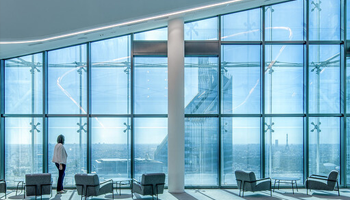

Smart Windows & Electrochromic Glass
Smart windows—especially electrochromic (EC) glass—are finally moving beyond prototypes and flagship skyscrapers. In 2025, commercialization is real, costs are trending down, and adoption is creeping from commercial into high-end residential. We’re not talking about passive tints anymore; we’re talking about glass that changes its light transmission on command to control glare, daylight, and solar heat gain.
If you’ve seen a demo, you know the “wow factor”: tap an app or trigger an automation and your glass wall darkens smoothly, preserving views while blocking harsh sun. That said, this is still premium technology. Expect pricing that sits above traditional high-performance windows plus motorized shades—but potentially replaces those shades altogether.
From the field: I consulted on a luxury home in Big Sur with ~800 sq ft of electrochromic glazing. The glass package alone ran $128,000. The homeowners loved sunset views without glare and skipped a $40,000 motorized shade system. For a $1.8M build, the calculus worked. For a standard home, it’s a tougher call.
Electrochromic Glass: The Core Technology
How Electrochromic Windows Work
Electrochromic glass uses a thin-film stack that moves ions when a low DC voltage is applied. That ion movement changes the glass’s optical properties, shifting from clear to tinted and back. The tint is reversible (seconds to minutes depending on size and system), and there’s no permanent change to the substrate—just a different state.
Tint Range and Control
Modern EC products modulate visible light transmission from roughly 3% (very dark) up to ~99% (clear), with many intermediate states. You can control tint manually by app, wall switch, or voice, or let automations handle it based on sun position, time of day, or interior targets (lux levels, glare thresholds).
Energy Consumption of Tinting
Power demand is minimal (typically 3–5 volts DC), needed only during the transition. Once a state is reached, it’s “latched” without continuous power. If a power outage hits mid-day, the windows stay where they were; they simply won’t change states until power returns.
Types of Smart Glass Technologies
Electrochromic (EC): Market Leader
EC currently leads for building applications because it offers fine-grained control, strong solar performance, and mature integrations. It’s also the most expensive class of smart glazing, with deep vendor ecosystems, commissioning procedures, and building-automation compatibility.
Thermochromic: Temperature-Triggered
Thermochromic laminates darken as surface temperatures rise. They require no wiring or power, but they’re fully automatic—no manual override—so they can tint at times you’d prefer clarity. Lower cost, lower control.
Photochromic: Light-Responsive
Think “transition sunglasses” for buildings. The glass responds to UV/visible light but lacks electrical control, which limits precision. Good for niche daylight management; less ideal when you want schedule- or zone-based logic.
SPD (Suspended Particle Device)
SPD suspends microscopic particles that align under voltage, achieving very fast transitions and deep tints. It shines in automotive and aviation, where speed and dynamic glare control are critical. In buildings, SPD remains niche versus EC.
Leading Smart Window Manufacturers
View Dynamic Glass
A leader in large commercial installs and increasingly in residential. Robust app, scene presets, and BACnet/Modbus integrations. Typical installed cost: $80–$150 per sq ft.
SageGlass (Saint-Gobain)
European technology pedigree with decades of performance data and many campus-scale deployments. Installed cost often lands $70–$130 per sq ft depending on scope, controls, and glazing geometry.
Halio
Positions itself on faster tinting—on the order of ~3 minutes versus ~15–20 for some competitors—aiming to split the difference between EC precision and SPD speed. Installed cost: $85–$140 per sq ft.
Emerging Players
Kinestral and DMDisplay bring competitive pricing and new approaches. We expect more regional players and OEM partnerships as supply chains mature.
Performance Benefits and Energy Savings
Solar Heat Gain Management
Electrochromic glass dynamically shifts the Solar Heat Gain Coefficient (SHGC) in use—think ~0.09–0.48 depending on tint state—so you can trim cooling loads when you need it most. In hot climates or west-facing facades, this flexibility reduces HVAC loads ~20–30% and helps shave peak demand.
Glare Control Without Blinds
With a proper control strategy, you maintain views while killing the veiling luminance that makes monitors unreadable. Many projects eliminate interior shades altogether, saving procurement, motors, wiring, and long-term maintenance headaches.
From the field: I toured a south façade office tower outfitted with EC glass and automated sun-tracking. Tenant glare complaints dropped to zero. Cooling energy fell by ~24% compared to pre-retrofit operations—consistent with what building managers report once controls are tuned.
Daylighting Optimization
By modulating transmittance instead of slamming blinds shut, you keep more useful daylight hours, reduce artificial lighting needs, and support circadian-friendly interiors. Guidance from the LBNL Windows & Daylighting group and ASHRAE can help you set interior illuminance targets and glare metrics.
Actual Energy Savings Data
Typical outcomes (context-dependent): 20–30% HVAC cost reduction for commercial; 15–25% for well-designed residential. Real ROI depends on energy rates, glazing area, climate, and whether you’re avoiding motorized shades.
Cost Analysis: Premium Technology Pricing
Product Cost Breakdown
- Smart glass panels: $50–$100/sq ft
- Control system + commissioning: $2,000–$5,000+ per project
- Installation (wiring + glazing labor): $20–$40/sq ft
- Total installed: $80–$150/sq ft (scope and geometry drive variance)
Traditional Windows + Shades Comparison
- Premium low-E window package: $30–$50/sq ft
- Motorized shades: $30–$60/sq ft
- Combined: $60–$110/sq ft
- EC premium: generally 20–40% more than the combo
Payback Period Calculations
- Energy savings only: 15–25 years
- Including shade elimination: 10–15 years
- Comfort/convenience value: subjective but real—especially in view-centric spaces
From the field: Over the last few years I’ve seen electrochromic quotes fall from $140–$160 to $100–$120 per sq ft for similar specs. If that curve heads below $80/sq ft (plausible by 2030), residential ROI opens up dramatically.
Tip: Run both options through a side-by-side estimator: EC vs premium windows + motorized shades. If the EC premium is <40%, it’s worth serious consideration. If >60%, most homeowners are happier with great glass + good shades.
Smart Home Integration
Control Options
App (iOS/Android), wall switches, voice assistants (Alexa/Google/Siri), schedules (weekday/weekend), and sensor-based triggers (illuminance, outdoor temp). You can even blend manual “scenes” with automated safety rules.
Integration with Home Systems
EC windows play nicely with thermostats (Nest, Ecobee, Honeywell) and whole-home platforms (Control4, Crestron), often via BACnet or custom APIs. For DIY logic, IFTTT-style applets can coordinate tint with HVAC setpoints or occupancy.
Zone Control and Programming
Divide glazing into zones—by orientation, floor, or space type—to avoid overtinting. Seasonal presets help: e.g., winter “bright” scenes to chase solar gains, summer “cool” scenes to block late-afternoon heat.
Residential vs Commercial Applications
Where Residential Makes Sense
- Large south/west glass walls, modern architecture, or net-zero goals
- Projects already budgeting for high-end glazing and motorized shades
- Luxury builds and high-comfort renovations where “no shades, full view” is part of the brief
Commercial Dominance
- Offices, hospitals, labs, schools, and hotels are still the core EC market
- Scale unlocks pricing; utility incentives and tax benefits help the business case
From the field: Residential availability remains a bottleneck. On one project I could only locate three qualified EC installers across the U.S. Southwest willing to take a custom home. That scarcity adds soft costs and schedule risk.
Installation and Retrofitting Considerations
New Construction Integration
New builds make wiring and controls painless. You’ll coordinate conduit paths, low-voltage homeruns, and control enclosures early, often lowering installed cost.
Retrofit Challenges
Retrofitting EC into existing frames is possible but complex. Expect higher labor, soffit chases for wire, and finish repairs. Many contractors shy away due to unfamiliarity and warranty concerns.
IGU Replacement vs Full Frame
Some systems allow insulated glass unit (IGU) swap-outs into existing frames—huge cost saver when compatible. Always confirm structural, sealant, and warranty requirements with the vendor.
Durability and Lifespan Expectations
Quality electrochromic systems target 20–30 years of service life (on par with premium fenestration). Warranties typically run 10–20 years on glass and 2–5 years on electronics. Cycle life north of 50,000 transitions is common. Maintenance is light: periodic software updates and the same cleaning you’d do on any high-performance glazing.
Limitations and Challenges
- High Upfront Cost: Premium pricing vs glass+shade bundles
- Limited Residential Installer Network: Fewer crews = scheduling friction
- Power Requirement: Minor, but you still need low-voltage planning and a home run to each zone
- Tinting Speed: Minutes, not instant—fine for automation, requires patience for manual “on the spot” changes
- Color Cast: Many EC tints skew blue/gray; “perfectly neutral” is improving but not universal
- Size Limits: Very large lites may need mullions or custom fabrication sequences
From the field: Clients sometimes expect sunglasses-speed darkening. Realistically, 5–15 minutes is typical for large EC panes. Halio claims around 3 minutes in many scenarios. With automated sun-tracking, the system pre-tints before glare hits, so speed matters less day-to-day.
Alternative Smart Window Technologies
PDLC (Polymer Dispersed Liquid Crystal) Privacy Glass
This is privacy, not tint. It flips clear ↔︎ frosted instantly with power. Great for bathrooms and conference rooms. Typical cost $60–$100/sq ft installed.
From the field: I specified PDLC for a glass shower enclosure at ~$85/sq ft. Clear for an open spa vibe; frosted at the switch for privacy. Zero energy-savings claim—just the right tool for the job.
Static Tinted Low-E Glass
A budget-friendly alternative: the tint is fixed and passive. Add quality low-E coatings, and you get decent solar control for a tiny premium ($5–$15/sq ft) over standard glass—but no dynamic flexibility.
Future Developments and Trends
- Cost Curve: A realistic ~50% cost reduction by 2030 would unlock mainstream residential
- Faster Transitions: Material stacks and controls aimed at sub-5-minute full-pane shifts
- PV Integration: Electrochromic + thin-film photovoltaics to offset control energy and feed home loads
- Truer Neutrals: Better color rendition for design-sensitive applications
- Residential Growth: As distribution and installer networks mature, expect more home-scale packages and simpler commissioning
For broader context on building-energy impacts, see the U.S. Department of Energy and NREL primers on envelope efficiency and peak-demand management.
ROI Decision Framework
When Smart Glass Makes Financial Sense
- Glazing area >200 sq ft, especially west/south exposures
- High energy rates (≥$0.18/kWh) or demand charges
- Long-term ownership (>15 years)
- New construction or deep retrofit with shade elimination
- Commercial projects with incentives or tax advantages
When to Stick with Traditional Windows
- Small glazing areas or well-shaded façades
- Tight budgets or short ownership horizon
- Adequate passive solutions (overhangs, spectrally selective low-E, good blinds)
Real-World Case Studies
Luxury Residential: Malibu Beach House
600 sq ft of EC glass (~$90k for glass) on an ocean-facing wall. The owners prioritized glare-free sunsets and a clean, shade-less aesthetic. Energy savings helped, but the value proposition was comfort + design.
Commercial Retrofit: Office Tower
~10,000 sq ft of EC (roughly $1.2M installed) on a south façade. Integrated with BAS for sun position and cloud cover. Tenants reported instant comfort gains; building operations logged significant cooling savings and reduced peak loads.
Passive House: Net-Zero Home
Targeted EC on west glass mitigated late-day overheating while preserving daylight—allowing smaller cooling equipment and better occupant comfort without heavy shading systems.
Making the Decision: Is It Right for You?
Use this checklist:
- Do you have large, view-critical glazing where blinds would ruin the aesthetic?
- Are you open to smart-home automation and tuning controls for a month or two?
- Will EC replace motorized shades you would otherwise buy?
- Is the premium <40% vs the combined cost of premium glass + shades?
- Do you plan to own the building for 15+ years?
From the field: The surest wins I’ve seen are homes or offices that would have bought shades anyway. When EC lets you delete a finicky mechanical system, ROI tightens—and everyday experience improves.
Smart glass sits inside a bigger envelope strategy—start with the fundamentals in our Windows & Doors hub. If you’re comparing dynamic tinting to traditional operable units, see how sealing and day-to-day usability change in our double-hung windows guide.
FAQs (Straight Answers)
How much do electrochromic smart windows cost per square foot?
Expect $80–$150/sq ft installed, depending on size, wiring complexity, controls, and glazing geometry.
Electrochromic windows energy savings percentage—what’s realistic?
Commercial: ~20–30% HVAC cost reductions are common with tuned controls. Residential: ~15–25% in well-designed applications.
Are smart windows worth it for residential?
They can be—especially for modern homes with >400 sq ft of solar-exposed glazing where you’d otherwise buy motorized shades. If the EC premium is under ~40% vs glass+shades, the experience and maintenance wins often justify it.
Smart windows vs motorized shades: which costs more?
Upfront, EC usually costs 20–40% more than a premium window + motorized shade bundle. But EC can eliminate shade purchases and long-term shade failures.
Can you retrofit smart glass in an existing home?
Yes, but wiring and finish work add cost. Some projects support IGU swap-outs without full frame replacement; others require new frames.
How fast do electrochromic windows tint?
Plan on minutes, not seconds. Many large panes take 5–15 minutes to go clear→dark; some systems claim ~3 minutes for typical transitions.
What happens during a power outage?
The glass stays in its last state. It won’t change until power returns.
Electrochromic smart windows deliver real, measurable benefits—glare control without blinds, better daylighting, and lower cooling loads—wrapped in a “glass that darkens on command” experience. They’re still a premium buy, but costs are easing, and the best use cases already pencil out, especially when they replace motorized shades. If you’re building or renovating with large view-centric glazing, run the numbers both ways. For many projects in 2025, the future of windows is already on the table.