

How Long Do Asphalt Shingles Really Last? Lifespan by Brand
If you’re hoping a “30-year shingle” will sail to year 30, here’s the uncomfortable truth: lab ratings aren’t real-world lifespans. Manufacturers test under controlled conditions most roofs never see. In practice, weather, attic heat, sun exposure, installation quality, and maintenance dictate how long your roof lives.
Insider truth: In 20 years of roofing, I’ve never seen an asphalt shingle roof hit its full rated lifespan. Never. Perfect lab conditions don’t exist on real houses, and field variables win every time.
Marketing vs. reality isn’t about “lying”—it’s about assumptions. Those “perfect” assumptions (ideal ventilation, correct nailing, uniform substrate, balanced attic temps, no harsh microclimate) are fragile. Knock out any one of them and you shorten service life.
What actually moves the needle:
- Installation quality (fasteners, pattern, sealing, decking prep): the #1 determinant.
- Ventilation (intake + exhaust balance): overheated attics cook shingles from below.
- Climate and exposure (UV, wind, hail, humidity): accelerants of aging.
- Maintenance (gutters, moss control, inspections): prevents small issues from compounding.
Average Lifespan by Shingle Type
Real-world ranges below reflect field performance, not brochure claims.
3-Tab Shingles: 12–18 Years (15–20 in mild climates)
Budget-friendly and thin. They age faster under heat and wind uplift. In hot-sun markets (TX/AZ), plan on 10–15 years max. In milder, well-ventilated settings, 15–20 is achievable, but 25 is rare.
Architectural (Dimensional): 20–30 Years (common: 22–26)
Heavier mat and laminated profile improve wind resistance and shadow lines. Most homeowners buy here. Installed correctly with balanced ventilation, expect ~22–26 years; gentle climates can stretch toward 30.
Premium/Luxury Architectural: 28–35 Years
Thicker lamination and stronger mats. With spot-on installation and care, you’ll see high-20s to mid-30s. These can approach rated numbers if every variable is dialed.
Designer Shingles: 35–45+ Years (best-case)
Flagship lines mimic slate/wood. They can approach claims in kinder climates with meticulous install + ventilation, but don’t bank on the brochure’s top end outside ideal conditions.
Lifespan by Major Brand
Insider note: I’ve seen $200/sq roofs outlast $400/sq roofs because the cheap one was installed perfectly and the pricey one was a rush job. The brand matters—but execution matters more.
GAF Timberline Series — 22–28 years
Workhorse architectural line. Strong performer when nailed per spec and paired with adequate intake/exhaust ventilation.
Owens Corning Duration — 25–30 years
Stout nailing zone and consistent lamination. With correct fastener count and attic temps under control, late-20s is realistic.
CertainTeed Landmark — 24–30 years
Heavier feel; good consistency. Expect mid-20s; properly ventilated roofs can flirt with ~30.
Malarkey Vista — 20–25 years
Reliable, especially in moderate climates. Keep the attic cool and edges sealed to stay in the 20s.
IKO Cambridge — 18–25 years
Pay close attention to nailing and seal-down in windy zones. Good installs land in the low-20s.
Atlas Pinnacle — 25–32 years
Solid wind performance when nailed correctly. Top-end results require textbook ventilation and maintenance.
Climate Impact on Shingle Lifespan
- Hot climates (thermal degradation): Sustained attic temps over ~150–160°F accelerate asphalt oxidation.
Insider metric: I’ve measured 180°F attics in summer; that’s a lifespan killer. - Cold climates (freeze–thaw): Micro-cracking, brittleness, and ice dams stress laminations and edges.
- Humid regions (moss & algae): Biological growth traps moisture, lifts edges, and sheds granules.
- Hurricane/High-wind zones: Uplift exploits under-nailing and poor sealing; 6-nail patterns often required for wind warranties.
- Hail-prone areas: Impact scours granules (UV shield), bruises mats, and shortens serviceable life. Consider Class 3/4 impact-rated options.
Insider tip: South-facing planes in sunny states can die 3–5 years earlier than north-facing ones. UV is cumulative.
Lifespan isn’t a brochure claim—it’s installation plus airflow. Use the roofing systems hub to scope the stack, then see upgrade math in architectural shingles vs 3-tab.
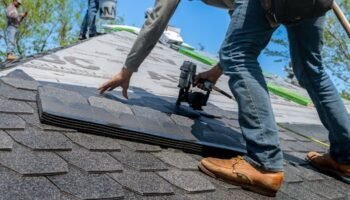
Installation Quality: The #1 Factor
Even premium shingles fail in ~10 years under poor installation. What “good” looks like:
- Correct nailing: Use the manufacturer’s pattern and nail line. (Standard conditions often allow 4 nails; high-wind specs commonly require 6 to maintain wind warranties.) Nails must be flush—not high, not over-driven.
- Deck prep: Solid, clean, dry sheathing; replace spongy or delaminated OSB/ply before roofing.
- Underlayment: Proper ice/water shield at eaves/valleys; synthetic or felt per climate and code.
- Starter & edge metals: True starters at eaves/rakes and drip edge stop capillary back-flow and edge curl.
- Ventilation: Balance intake (soffit) and exhaust (ridge/gable). Target code-compliant net free area and actual airflow, not just “vents present.”
Insider line I stand by: “How long will this roof last?” depends more on my crew than the shingle you pick.
Maintenance Practices That Extend Life
- Gutters: Clean every spring/fall (quarterly if heavy leaf load). Overflow drives water under edges.
- Moss/algae: Keep debris off; consider zinc/copper strips near ridge; use non-bleach, shingle-safe washes.
- Trees: Trim back limbs to reduce shade (moss) and branch abrasion.
- Annual inspection checklist:
- Fastener pops, lifted tabs, open ridge/hips
- Exposed nail heads sealed or re-fastened
- Flashings (chimney, wall, skylight) tight and counter-flashed
- Pipe boots intact, not cracked
- Granules in gutters—watch for sudden spikes
- Attic: daylight where it shouldn’t be, signs of moisture, insulation blocking soffits
Warning Signs Your Shingles Are Failing
- Granule loss (heavy in gutters or bald spots on slopes)
- Curling/cupping edges and lifted laminations
- Missing or cracked shingles after routine winds
- Dark streaks/discoloration (algae) and inconsistent shading from patchwork repairs
- Sagging areas (possible deck damage or structural issues)
Warranty vs. Actual Lifespan
- Prorated realities: Many “lifetime”/“limited lifetime” warranties prorate after ~10 years—coverage tapers fast.
- What voids coverage: Under-nailing, high/over-driven nails, inadequate ventilation, non-approved accessories, or improper underlayment details.
- Limited vs. lifetime: “Lifetime” refers to product defects, not guaranteed years on your roof. It does not override climate, install, or maintenance.
Insider warning: A shingle failing in year 20 may see materials partially covered—labor/tear-off/disposal still mostly on you.
Cost-Per-Year Analysis
The fairest way to compare shingles is total installed price ÷ realistic years of service. Use your actual quote; example math below assumes a $12,000 full replacement (tear-off, underlayment, flashings, ventilation, labor).
Formula: Cost per year = Installed price ÷ Expected years
Sample Comparison (Same $12,000 job; lifespan = field range midpoint)
| Brand/Type | Expected Years | Cost/Year |
|---|---|---|
| 3-Tab (midpoint 15) | 15 | $800 |
| GAF Timberline | 25 | $480 |
| Owens Corning Duration | 28 | $429 |
| CertainTeed Landmark | 27 | $444 |
| Malarkey Vista | 22.5 | $533 |
| IKO Cambridge | 21.5 | $558 |
| Atlas Pinnacle | 28.5 | $421 |
| Premium Architectural | 31.5 | $381 |
| Designer/Luxury | 40 | $300 |
How to use this: Replace $12,000 with your real bid(s). If you’re in a harsh climate or have a south-facing barn burner of a roof, bump expected years down ~10–20% and recalc.
How to Maximize Your Shingles’ Life
- Hire for installation excellence, not just brand. Ask about nailing pattern, supervision, and final QA.
- Balance ventilation (soffit + ridge) and verify net free area calcs, not just “we added a vent.”
- Specify the details: real starters at eaves/rakes, ice/water where needed, sealed penetrations, drip edge.
- Schedule maintenance: clean gutters, trim trees, annual roof/attic checks.
- Document everything: photos of underlayment, nail line, venting—helps with future warranty questions.
When to Replace vs. Repair (Simple Decision Framework)
- Under 12 years, minor damage, no leaks: Repair and monitor.
- 15–20 years with multiple warning signs (curling, granule loss, recurring blow-offs): Plan replacement within the next 12 months.
- Active leaks, soft decking, or widespread blistering at any age: Prioritize replacement—deck failures compound costs.
- Storm damage localized: If the mat isn’t brittle and color-match is acceptable, spot repairs can buy 2–5 years.
- South-facing slopes failing early: Consider slope-specific replacement if budget is tight.
FAQs
How long do GAF Timberline HDZ shingles really last in practice?
About 22–28 years with correct nailing, sealed edges, and balanced attic ventilation. Poor install or hot attics can cut that to the teens.
Why do 30-year architectural shingles only last ~20 years?
Because “30” assumes perfect variables. UV, attic heat, wind, and installation errors compound. Real houses aren’t labs, so 20–26 is a common result.
What is the actual lifespan of Owens Corning Duration shingles?
25–30 years in well-ventilated, properly installed systems—with maintenance. Expect the mid-to-high-20s in average U.S. conditions.
How to tell if my asphalt shingles are at end of life?
Look for heavy granules in gutters, curling edges, brittle mats/blistering, and recurring blow-offs after modest winds. If you can snap tabs by hand, it’s time.
Do CertainTeed Landmark shingles last longer than GAF Timberline?
In the field, both land in the mid-20s when installed/vented correctly. The crew and ventilation design often decide the winner more than the logo.
If you take one thing away, make it this: installation + ventilation > brand. Pick a reputable shingle, but hire a contractor who obsesses over the nail line, underlayment, flashings, and airflow—and then maintain the system. Do that, and a “30-year” roof has a real shot at the high-20s. Skip those fundamentals, and even a premium shingle can fail in a decade.